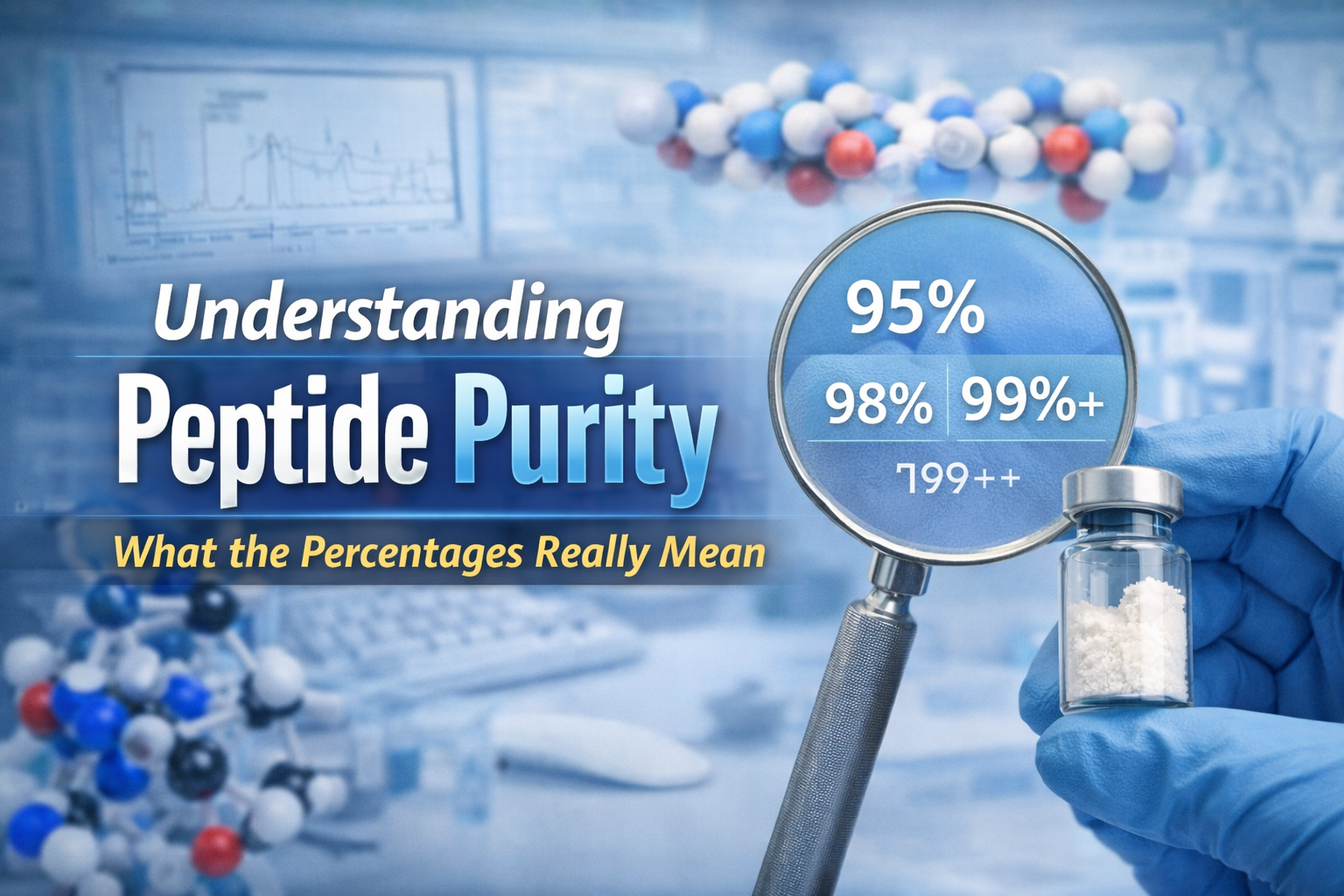
Comprehending Peptide Purity Testing
Exactly How To Confirm Research Study Peptide Pureness: Coa & Hplc Lab Guide " Tailing"-- where the top trails off slowly on one side-- can show column issues, example overloading, or secondary interactions between the peptide and the stationary stage. The gold criterion for gauging peptide purity is high-performance fluid chromatography, widely abbreviated as HPLC. If you see a pureness portion on a peptide product, it almost certainly came from an HPLC evaluation. Analytical Chemistry Note the tiny peaks in heaven tirzepatide sample chromatogram that don't exist in the basic injections around it. These might be excipients or contaminations in the tirzepatide vial. Considered that they have a comparable retention time to tirzepatide, they may be impurities from the tirzepatide synthesis process, however they could also be contaminations from the other excipients in the vial. It's an additional action that provides scientists self-confidence that each peptide fulfills constant, proven criteria. Peptide pureness is normally expressed as a portion, such as 95% or 98%. This figure represents how much of the sample is made up of the wanted peptide series. For the majority of laboratory applications, a pureness of 95% or higher is considered research-grade. Previous short articles in this series have actually highlighted just how peptide synthesis has made it possible for the growth of a large range of powerful injections and healing agents. GLP-1 agonists and related compounds for fat burning applications bring particular concerns. These peptides work through particular receptor systems, making identification verification specifically vital. A compound with comparable yet various task could produce unforeseen impacts. Finnrick offers free peptide screening for examples shipped to their facility.
The Parts Of An Hplc System
What equipment is utilized to check peptide purity?
Peptide purity is consistently established by HPLC (high efficiency liquid chromatography). This method makes it possible for separation and loved one quantification of each peptide manufactured. If paired to a mass spectrometer (MS), this supplies molecular mass/ identification information of the target peptide and coming with impurities.

Selecting The Best Access On A Peptide Distributors Checklist
Crude peptides are suitable for applications where purity isn't important, such as antibody manufacturing or first screening assays where the target peptide simply needs to be present, not leading. Mass spectrometry measures the molecular weight of a compound with extreme accuracy. For peptides, one of the most common methods are electrospray ionization (ESI-MS) and matrix-assisted laser desorption/ionization time-of-flight (MALDI-TOF). HPLC divides a blend right into its specific components based on exactly how each molecule connects with a specially created column. The liquified peptide example is injected right into a stream of fluid solvent (the mobile Additional hints phase) that streams via a tube packed with tiny fragments (the fixed stage). Various molecules "stick" to those particles with various strengths, so they travel via the column at different speeds.- One usual misconception is that an extremely pure peptide will certainly always liquify immediately.
- Over a chain of 10, 20, or 40 amino acids, those tiny per-step error prices substance.
- Qing Li Peptide warranties this through rigorous production and QC.
- Keeping a high degree of purity is crucial since contaminations can affect bioassays or responses.